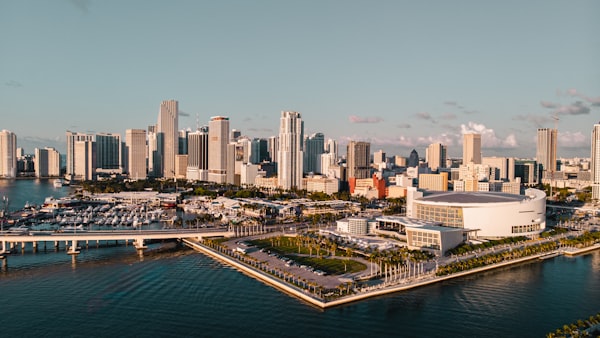
I had two conversations this week that, on paper, made no sense together. The first was with a couple looking at a single-family home in the mid-$600s. They were nervous — convinced they needed to come in at full asking and waive everything to have a shot. I had to slow them down. The second was with a buyer chasing a $2.3 million bayfront condo who assumed he had all the leverage in the world because "everybody says the market is soft right now." I had to slow him down too — in the opposite direction.
Both of them were reading the same headlines. Both of them were wrong about their own situation. That is what is happening in Miami right now: we do not have one market, we have two. And if you do not know which one you are standing in, you are going to make the wrong move with real money on the line.
The mainstream market has cooled — and that's good news if you're buying
Let me give you the numbers, because they tell the story plainly. As of June 2026, the typical Miami home is taking around 87 days to sell. A year ago that figure was closer to 75. Inventory is sitting near a 4.7-month supply — still tight by historical standards, where six months is considered balanced, but a meaningful loosening from where we were. And the median sale price actually slipped about 1.2% year over year.
None of that is a crash. I want to be direct about that, because fear sells and I am not in the business of selling fear. What it is, is breathing room. For the first time in a while, buyers in the mainstream price tiers — call it everything under roughly a million dollars — have time to think, room to inspect, and standing to negotiate. When a listing sits past the local average, the seller starts doing math in their head. That is where the leverage lives.
I tell my clients in this tier the same thing every time: the asking price is the start of a conversation, not the end of one. In this environment I am winning price reductions, seller-paid closing costs, rate buydowns that knock the monthly payment down for the first couple of years, and repair credits I would not have gotten in 2023. The buyers who lose right now are the ones still negotiating like it is a frenzy that ended a year ago.
Miami Market Snapshot — Mid-2026
Median sale price: ~$595K, down ~1.2% YoY | Days on market: ~87 (vs. ~75 a year ago) | Supply: ~4.7 months | Luxury ($1M+) sales: up 21%+ YoY | All-cash share: ~44% overall, 80%+ above $10M
Now look at the top of the market — completely different weather
Here is where it flips. While the mainstream market is handing buyers leverage, Miami's luxury segment is doing the opposite. Sales of homes priced at a million dollars and up surged more than 21% year over year heading into mid-2026. In May, million-dollar-plus sales in Miami-Dade climbed nearly 15%, and the luxury single-family slice jumped almost 27%. That is not a cooling market. That is a market with its foot on the gas.
So how can the high end be sprinting while everything below it catches its breath? One word: cash. All-cash purchases make up roughly 44% of Miami closings — and at the very top, above $10 million, more than 80% of deals are all cash. When a buyer is not borrowing, a 6.7% mortgage rate is just a headline to them, not a constraint. The thing that throttles the mainstream market simply does not apply up there.
And the demand behind that cash is structural, not a fluke. We are still absorbing wealth relocating out of New York and California, plus international capital that treats Miami as a safe harbor. Those buyers are not waiting for rates to drop. They are competing with each other for a limited set of irreplaceable addresses — the bayfront positions, the oceanfront lines, the buildings that simply cannot be reproduced. That competition keeps prices firm and, in the best buildings, rising.
The mistake I see most often is a buyer importing the mood of one market into the other. Soft headlines do not give you leverage on a trophy property, and luxury euphoria should not make you overpay for a starter home that has been sitting for sixty days.
How I tell clients to play each side
If you're buying in the mainstream tiers
Use the clock. Days on market is the single most useful number you have, and most buyers ignore it. A home that has been listed longer than the area average is a home whose seller is recalibrating, and that is exactly where I push hardest on price and terms. Get fully underwritten before you shop — not just pre-qualified — so that when we find leverage, you can move on it without your financing becoming the weak link. And do not let anyone rush you into waiving inspections. In a market giving you time, time is the advantage. Use it.
If you're buying in luxury
Drop the bargain-hunting posture, because it will cost you the property. In the segments that are surging, the play is not squeezing the seller for ten percent — it is being the cleanest, most credible buyer in the room. Proof of funds ready, terms tight, decision-making fast. Where I create value for luxury clients is not by winning a lowball; it is by knowing which buildings have genuine scarcity and durable demand versus which ones are riding a marketing wave that will not hold. That distinction is worth far more than a discount on the wrong asset.
If you're a seller caught in between
Price to the market you are actually in, not the one from two years ago. If your home is in the mainstream tiers, it has to be sharp on day one — clean, staged, and priced to the comps — because buyers have options and patience now. If you are sitting on a true luxury property in a sought-after location, you have the wind at your back, but presentation and positioning still decide whether you capture the top of the range or leave money behind.
The bigger picture
A two-speed market is not a problem to be afraid of. It is an opportunity for anyone willing to understand where they actually stand. The danger is only in the confusion — in acting on the wrong half of the story. The couple in the mid-$600s did not need to waive their protections; they needed someone to show them how much room they really had. The buyer chasing the bayfront condo did not need to wait for a discount that was never coming; he needed to be ready to win.
That is the work. Read the market you are actually in, not the one in the headline, and move accordingly. This is the same lesson my own life keeps teaching me — that strategy beats emotion, that discipline beats panic, and that the people who win are the ones who see clearly when everyone around them is reacting.
Buy the home. Protect the family. Build the legacy. Whichever side of this market you are standing on, every decision we make together should serve all three. If you want a straight read on where you actually have leverage right now — and where you do not — call me at (954) 702-4688 or visit HomeWithAgu.com. Let's build something real.